

Edelrid HELIA 2026: PFAS-Free Climbing Harness With 3D-Vent Waistbelt
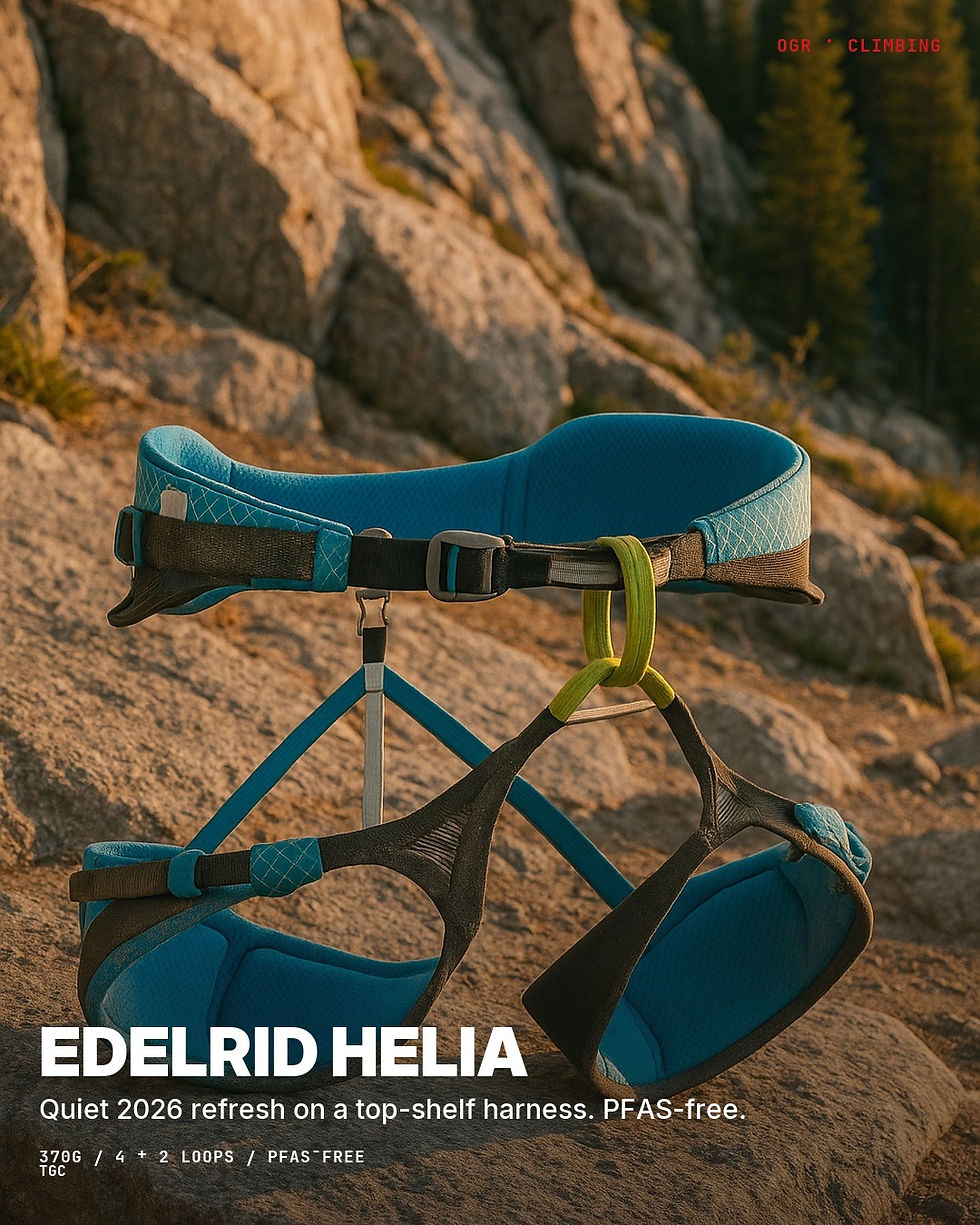
Edelrid quietly refreshed their HELIA harness for 2026 and used the update to ship the climbing industry's first major PFAS-free harness construction. The Edelrid HELIA is the brand's high-end all-around piece, sitting alongside the HELIOS in Edelrid's top tier. 370 grams, four gear loops plus two ice clipper slots, a 3D-Vent waistbelt with edge-load distribution, abrasion-indicator tie-in points, and around $135 USD. For climbers who care about both German engineering and PFAS-free chemistry, the Edelrid HELIA is the harness that finally lines both up.
What it is
The Edelrid HELIA is Edelrid's high-end performance harness, refreshed for 2026. The construction targets all-around use across sport climbing, trad climbing, multipitch, and alpinism. The 2026 generation tweaks construction details from the prior generation, refines waistbelt and leg loop padding based on rider feedback, updates gear loop placement, and rolls out the PFAS-free DWR across all soft components.
The waistbelt is the 3D-Vent construction that distributes edge loads while keeping ventilation channels open. The leg loops carry refined padding and a no-thread Auto Double-Back belay buckle. Four standard gear loops plus two ice clipper slots cover the carry capacity for both rock and ice. Tie-in points are reinforced with an abrasion indicator for service-life signaling. Around $135 USD, shipping spring 2026 from edelrid.com US and EU.
Specs that matter
Weight: ~370 g (size M, target)
Waistbelt: 3D-Vent with edge-load distribution
Gear loops: 4 standard plus 2 ice clipper slots
Tie-in points: Reinforced, abrasion indicator
Belay buckle: Auto Double-Back, no thread
DWR: PFAS-free across all soft components
Use case: Sport, trad, multipitch, alpinism
Price: ~$135 USD
A few of these earn a closer look.
The PFAS-free DWR pass is the headline materials story for the 2026 generation. Per- and polyfluoroalkyl substances have been the standard chemistry for water-repellent treatments across outdoor gear for decades. Climbing harnesses are typically PFAS-treated to shed sweat and water during multi-pitch routes. Edelrid removed PFAS from all DWR touch points across the HELIA, which is the bare minimum modern environmental expectation but also the spec most brands have not yet hit on UIAA-rated soft goods.
The 3D-Vent waistbelt is the construction differentiator against most all-around harnesses. Standard waistbelt constructions concentrate load along the top edge during a hanging belay, which creates pressure points that cause discomfort on long routes. The 3D-Vent structure distributes load across multiple contact points and keeps airflow channels open between the waistbelt and the body. For multi-pitch climbers and alpinists who hang in their harness for hours at a time, the construction matters.
The Auto Double-Back belay buckle is the safety detail. Single-pass belay buckles require the climber to thread the strap back through after tightening; if the rethread is forgotten, the buckle slips under load. Auto Double-Back buckles route the strap automatically, which removes the failure mode. Edelrid has been running Auto Double-Back across their high-end harnesses for several generations.
The abrasion-indicator tie-in points are the service-life signaling. Tie-in points are the highest-load contact zone on a harness, and they wear over time as the rope passes through during knot tying and loading. The abrasion indicator is a colored thread layer that becomes visible when the outer protective layer wears through. When the indicator shows, the harness is at end of service life. Most harnesses leave service-life judgment to the climber; Edelrid built it into the construction.

Materials & construction
The construction story is the convergence of refinement and chemistry. The HELIA is not a ground-up redesign for 2026; it is a deliberate refresh of an already-respected harness. The padding refinements come from rider feedback during the 2024 and 2025 seasons, which Edelrid systematically collected through their athlete program and dealer network.
The PFAS-free DWR is the chemistry change. The DWR is applied to the waistbelt webbing, the leg loop webbing, and the tie-in points. PFAS-free DWR formulations typically use silicone-based or wax-based chemistries that hit similar water-repellency performance with shorter durability life cycles. Edelrid has been testing PFAS-free formulations for several years; the HELIA 2026 is the harness where the formulation finally cleared their internal durability standards.
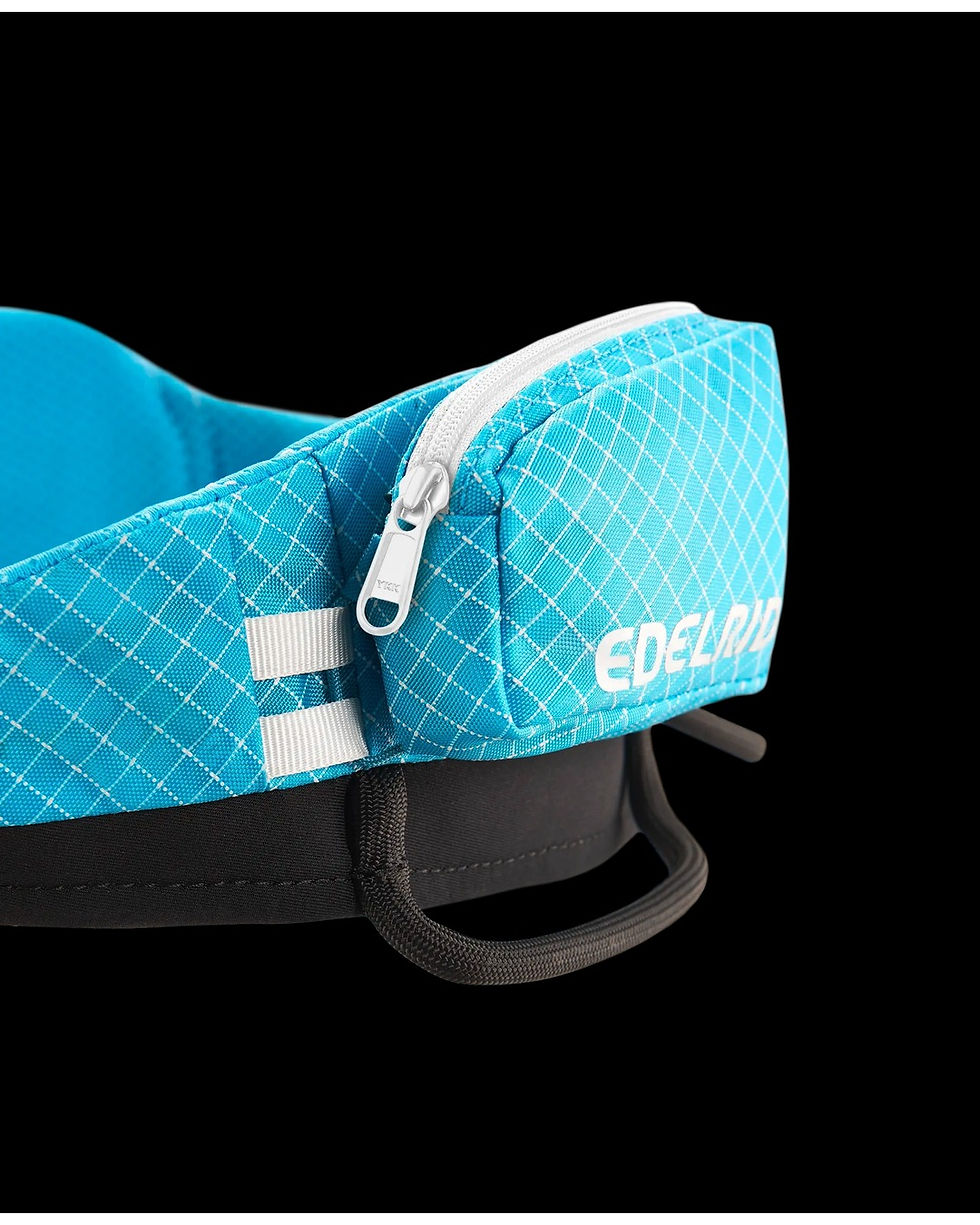
The 3D-Vent waistbelt construction uses a multi-layer foam structure with channels molded into the inner layer that contacts the body. The outer layer is a more abrasion-resistant fabric that takes the rack contact during hanging belays. Between the layers, the foam is structured for both compression and ventilation.
The leg loops use a slightly softer foam compound than the waistbelt, which is the construction choice that lets the legs breathe without sacrificing edge stability. Most all-around harnesses use the same foam in both zones; the HELIA tunes the two independently.
Who it's for
The Edelrid HELIA is built for the all-around climber who wants one harness for sport, trad, multipitch, and the occasional ice or alpine route. Sport climbers logging 4-pitch routes in Spain, trad climbers running long protected routes in the UK or Yosemite, alpinists who add ice in winter and rock in summer, and multipitch climbers who spend real time hanging in their harness on belay.
It is the right pick for the climber who values the German engineering reputation, the PFAS-free chemistry, and the construction details (auto buckle, abrasion indicator, 3D waistbelt) that mid-tier harnesses skip. It is the right pick for climbers in the European market where Edelrid has the strongest brand pedigree.
It is the wrong pick for the speed-climbing or alpinism specialist who wants the lightest possible harness and minimal padding. The HELIA's all-around construction adds weight against a stripped-down race-style harness. Get the Edelrid Loopo Lite or the Petzl Sitta instead. It is also the wrong pick for the gym-only climber who never leaves the indoor wall; an entry-level harness is the right tool there.
A specific scenario this harness was made for: a 10-pitch trad route in the Wadi Rum region of Jordan, full rack of cams and nuts plus alpine draws, hanging belays at every transition, sweltering desert heat where the 3D-Vent construction earns its keep on every belay station.

How it compares
Against the Petzl Adjama (around $90, 480 g, 4 gear loops): Adjama is the broader-distribution all-around harness. Petzl wins on price; Edelrid wins on weight, the 3D-Vent waistbelt, and the PFAS-free chemistry.
Against the Black Diamond Solution (around $80, 360 g, 4 gear loops): Solution is the spec-comparable competitor at lower price. BD wins on price; Edelrid wins on the abrasion indicator, the auto buckle, and the PFAS-free DWR.
Against the Edelrid HELIOS (around $145, 380 g, 4 loops): HELIOS is the sibling in Edelrid's top tier. HELIOS uses a thinner waistbelt for a more streamlined feel; HELIA has the slightly more padded construction. For ice and alpine, HELIA. For pure rock, HELIOS.
Against the Arc'teryx AR-395a (around $190, 395 g, 4 loops): AR-395a is the higher-tier alpine all-arounder. Arc'teryx wins on durability and brand cachet; Edelrid wins on price and chemistry.
Where it shines (and where it doesn't)
It shines on multi-pitch routes where hanging belays are the rule, on long days where the 3D-Vent construction matters, and on routes where the rider values the abrasion indicator and the PFAS-free chemistry. It shines for climbers in the European market where Edelrid is the trust-anchor brand.
Where it does not shine: pure speed-climbing or stripped-down alpinism where every gram counts. The HELIA is too padded for that use case. It also does not shine for indoor-only gym use; the construction is overengineered for a sport-climbing-only application that never leaves the wall.
Where to buy Edelrid HELIA
The Edelrid HELIA is available at edelrid.com on the US and EU sites, and through authorized climbing specialty retailers. The 2026 generation is shipping spring 2026 at around $135 USD. Multi-colorway options are available across two to three color schemes per generation.
Frequently asked questions
What is the Edelrid HELIA?
The Edelrid HELIA is the German brand's high-end performance climbing harness, sitting alongside the HELIOS in Edelrid's top tier. The 2026 generation refreshes construction details, refines waistbelt and leg loop padding, updates gear loop placement, and rolls out a brand-wide PFAS-free DWR pass across all soft components. It targets sport, trad, multipitch, and alpinism use at around $135 USD.
How much does the Edelrid HELIA weigh?
The Edelrid HELIA weighs about 370 grams in a size medium. That weight class is mid-range for a high-end all-around harness, lighter than a fully padded big-wall harness and heavier than a stripped-down speed-climbing or alpinism harness. The HELIA's weight reflects its all-around use case across sport, trad, and multipitch.
How many gear loops does the Edelrid HELIA have?
The Edelrid HELIA has four standard gear loops plus two ice clipper slots. The four standard loops are positioned for trad rack distribution. The two ice clipper slots are sized for the Edelrid Ice Clipper or compatible ice screw racking. Six total carry points is the standard for an all-around harness that has to work across rock and ice disciplines.
Is the Edelrid HELIA good for trad climbing?
The Edelrid HELIA is well-suited to trad climbing through the four-loop gear distribution and the abrasion-indicator tie-in point construction. The 3D-Vent waistbelt distributes load across the hips for long hanging belays, which is where most all-around harnesses get tested. The HELIA is the harness most trad climbers in Europe rotate as their primary.
What is the 3D-Vent waistbelt on the Edelrid HELIA?
The 3D-Vent waistbelt on the Edelrid HELIA is a structured airflow construction that distributes edge loads across the waist while keeping ventilation channels open against the body. The 3D structure is engineered to reduce hot-spot pressure points during long hanging belays and to keep the waistbelt from becoming a sweat trap on warm-day routes.
Is the Edelrid HELIA PFAS-free?
The Edelrid HELIA 2026 generation is PFAS-free across all DWR-treated soft components. The PFAS-free pass is part of a brand-wide push by Edelrid to remove harmful per- and polyfluoroalkyl substances from UIAA-rated soft goods. The HELIA is among the first harness lines in the climbing industry to ship a fully PFAS-free DWR construction.
Where can I buy the Edelrid HELIA?
The Edelrid HELIA is available at edelrid.com US and EU sites and through authorized climbing specialty retailers. The 2026 generation is shipping spring 2026. Pricing runs around $135 USD. Multi-colorway options are available across two to three color schemes per generation.
The bottom line
Buy the Edelrid HELIA if you want a high-end all-around harness with the 3D-Vent waistbelt, the auto buckle, the abrasion indicator, and the PFAS-free DWR all in one harness. Skip it if you climb only at the gym or only at the speed-climbing extreme. The reason this matters: Edelrid is one of the few brands that ties the eco/material story to a specific SKU rather than a marketing campaign, and the HELIA 2026 is the harness that delivers the chemistry change without compromising the climbing performance.
Specs and pricing accurate as of 2026-04-29 when this post was published. Check the brand page for current availability and colorways.
FAQ
What is the Edelrid HELIA?
The Edelrid HELIA is the German brand's high-end performance climbing harness, sitting alongside the HELIOS in Edelrid's top tier. The 2026 generation refreshes construction details, refines waistbelt and leg loop padding, updates gear loop placement, and rolls out a brand-wide PFAS-free DWR pass across all soft components. It targets sport, trad, multipitch, and alpinism use at around $135 USD.
How much does the Edelrid HELIA weigh?
The Edelrid HELIA weighs about 370 grams in a size medium. That weight class is mid-range for a high-end all-around harness, lighter than a fully padded big-wall harness and heavier than a stripped-down speed-climbing or alpinism harness. The HELIA's weight reflects its all-around use case across sport, trad, and multipitch.
How many gear loops does the Edelrid HELIA have?
The Edelrid HELIA has four standard gear loops plus two ice clipper slots. The four standard loops are positioned for trad rack distribution. The two ice clipper slots are sized for the Edelrid Ice Clipper or compatible ice screw racking. Six total carry points is the standard for an all-around harness that has to work across rock and ice disciplines.
Is the Edelrid HELIA good for trad climbing?
The Edelrid HELIA is well-suited to trad climbing through the four-loop gear distribution and the abrasion-indicator tie-in point construction. The 3D-Vent waistbelt distributes load across the hips for long hanging belays, which is where most all-around harnesses get tested. The HELIA is the harness most trad climbers in Europe rotate as their primary.
What is the 3D-Vent waistbelt on the Edelrid HELIA?
The 3D-Vent waistbelt on the Edelrid HELIA is a structured airflow construction that distributes edge loads across the waist while keeping ventilation channels open against the body. The 3D structure is engineered to reduce hot-spot pressure points during long hanging belays and to keep the waistbelt from becoming a sweat trap on warm-day routes.
Is the Edelrid HELIA PFAS-free?
The Edelrid HELIA 2026 generation is PFAS-free across all DWR-treated soft components. The PFAS-free pass is part of a brand-wide push by Edelrid to remove harmful per- and polyfluoroalkyl substances from UIAA-rated soft goods. The HELIA is among the first harness lines in the climbing industry to ship a fully PFAS-free DWR construction.
Where can I buy the Edelrid HELIA?
The Edelrid HELIA is available at edelrid.com US and EU sites and through authorized climbing specialty retailers. The 2026 generation is shipping spring 2026. Pricing runs around $135 USD. Multi-colorway options are available across two to three color schemes per generation.


Comments