

The North Face Summit Breithorn 2026: 800-Fill Belay Jacket With Synthetic Hot Zones
The North Face refreshed the Summit Series Breithorn for spring 2026, and the construction story is the same as the original positioning: 800-fill ProDown in the body where down works, ThermoBall Eco synthetic fill at the shoulders, cuffs, and collar where moisture collapses down. The 2026 update refines the baffle pattern across the chest, adds a longer drop tail for harness coverage, and uses a recycled 30-denier Pertex Quantum face fabric. $400 USD. The Breithorn is the Summit Series piece athletes actually rotate at base camp and on belay.
What it is
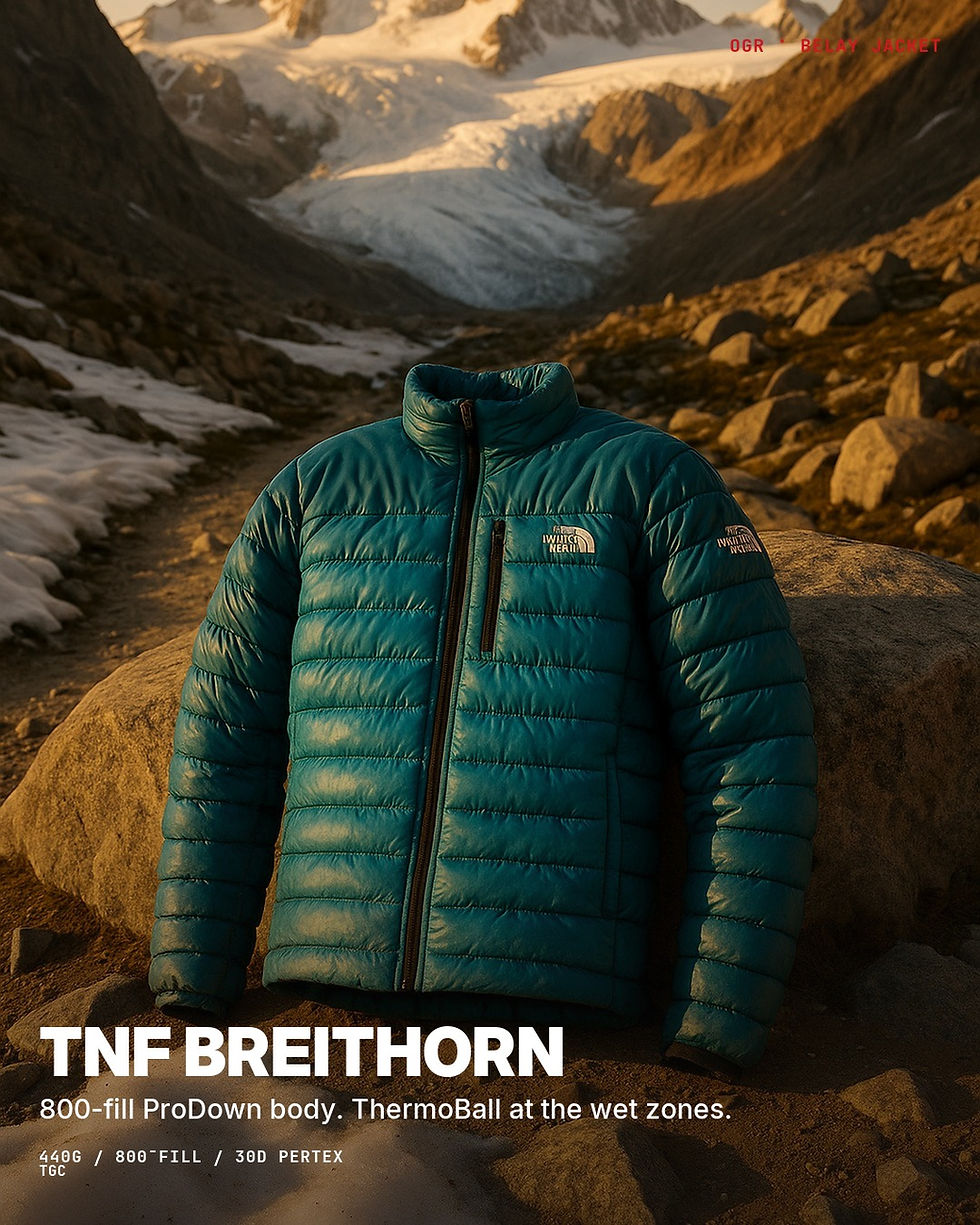
The North Face Summit Series Breithorn is the lighter, more packable companion to the heavier expedition-grade pieces in The North Face's top-tier alpine collection. The construction pairs 800-fill ProDown in the body baffles with 100 grams per square meter ThermoBall Eco synthetic fill at the shoulders, cuffs, and collar. The face fabric is 30-denier recycled Pertex Quantum with DWR treatment. The hood is helmet-compatible with a single-pull volume adjuster.
The 2026 spring drop refines the baffle pattern across the chest for more even loft distribution, adds a longer drop tail for harness coverage during sustained belay sessions, and updates the cuff construction. Pockets include two zippered hand pockets, one zippered chest, and one internal stash. The jacket packs into its own chest pocket. Around 440 grams in men's medium. $400 USD. Shipping now through The North Face Summit Series collection.
Specs that matter
Body insulation: 800-fill ProDown
Hot-zone insulation: 100 g/m² ThermoBall Eco synthetic at shoulders, cuffs, collar
Face fabric: 30D recycled Pertex Quantum with DWR
Weight: ~440 g (men's M)
Hood: Helmet-compatible, single-pull volume adjuster
Pockets: 2 zippered hand, 1 zippered chest, 1 internal stash
Packs into: Own chest pocket
Drop tail: Longer cut for harness coverage
Price: $400 USD
A few of these earn a closer look.
The 800-fill ProDown body with ThermoBall Eco hot zones is the construction that defines the Breithorn's category position. Pure down jackets collapse loft when wet; pure synthetic jackets weigh more per gram of warmth. The hybrid puts each insulation type where it performs best. ProDown in the chest, back, and lower arms (dry zones in most use). Synthetic at the shoulders (where pack straps trap sweat), the cuffs (where snow contact and skin moisture absorb), and the collar (where sweat from neck and chin pools).
The 30-denier recycled Pertex Quantum face fabric is the lightweight shell that keeps the Breithorn's weight class in check. Pertex Quantum is the long-running family of lightweight ripstop face fabrics used across belay and ultralight insulation pieces. The 30-denier weight is light enough to keep the jacket packable but durable enough to handle the abrasion of a climbing harness, a backpack, and the rock contact of an alpine belay station.
The longer drop tail is the harness-coverage detail that signals real climbing-use design. Standard belay jacket cuts stop at the waist or just below, which leaves the lower back exposed when the climber is sitting in a harness on belay. The longer drop tail covers the kidneys and lower back, which is the difference between a belay jacket that keeps the climber warm at the station and one that drafts cold air through the harness gap.
The packs into own chest pocket is the stowage detail. Belay jackets are not worn during the climb; they live in a pack and come out at the station. A jacket that packs into its own pocket compresses to a tight stowage size that fits in a summit pack without taking the volume of a third of the pack capacity.

Materials & construction
The construction story is the hybrid insulation engineering. The North Face has been refining the down-and-synthetic hybrid approach across multiple Summit Series pieces over several seasons. The Breithorn 2026 is the iteration where the placement of ThermoBall Eco hot zones is tuned specifically for belay use.
The 800-fill ProDown is The North Face's responsibly sourced down. ProDown carries the Responsible Down Standard certification, which means the down comes from suppliers audited for animal welfare practices. 800-fill is the loft rating; higher numbers indicate down that traps more air per gram, which translates to warmer-per-gram performance.
The ThermoBall Eco synthetic fill is The North Face's recycled-content synthetic insulation. ThermoBall fills are designed to clump like down clusters, which gives synthetic insulation a similar loft behavior to down. The Eco version uses recycled polyester fibers, which is the materials story that pairs with the ProDown's responsibly-sourced positioning.
The 30-denier Pertex Quantum face fabric is recycled-content nylon, which closes the materials story across the entire jacket. The DWR treatment is applied across the face fabric to shed light precipitation and snow contact during use. The DWR is a standard chemistry, not yet PFC-free across the line.
Who it's for
The North Face Summit Series Breithorn is built for the alpine climber, mountaineer, ski mountaineer, or expedition athlete who rotates a belay jacket on every trip. Single-push alpine routes where the climber needs warmth at every belay station. Multi-pitch ice climbing where the leader stops moving at every belay and needs to lock in heat. Ski mountaineering objectives where the wearer transitions between skiing and stopping at the summit. Base camp use during expedition trips where the jacket lives on a 12-hour rotation.
It is the right pick for the climber who wants 800-fill warmth without the moisture failure mode of pure down construction. It is also the right pick for the technical alpinist who values the Summit Series brand cachet and the pedigree of the line athletes rotate. It is the right pick for the ski mountaineer who skis hard objectives where weight matters and sweat is constant.
It is the wrong pick for the casual hiker or the backpacker who wants a budget belay jacket. The $400 price is the alpine-tier price, and the construction is engineered for technical use rather than casual warmth. Get the Patagonia Down Sweater or the Mountain Hardwear StretchDown instead. It is also the wrong pick for sustained wet conditions where pure synthetic fill is the right call; the Patagonia DAS Light Hoody or the Arc'teryx Atom AR are the better picks for that use case.
A specific scenario this jacket was made for: a 4-pitch ice climbing day in the Bow Valley, Canadian Rockies, sustained sub-zero temperatures, ice tool placements throughout the day, the jacket comes out at every belay and goes back in the pack at the start of every lead, with the climber's sweat soaking the shoulders and the snow contact wetting the cuffs.

How it compares
Against the Patagonia DAS Light Hoody (around $349, 405 g, PlumaFill synthetic): DAS Light is the pure-synthetic alternative with stronger wet-condition performance. Patagonia wins on sustained moisture environments; The North Face wins on dry-condition warmth-per-gram and the hybrid construction's broader applicability.
Against the Arc'teryx Atom AR (around $339, 410 g, Coreloft synthetic): Atom AR is the spec-comparable Arc'teryx option. Arc'teryx wins on cut precision and brand cachet; The North Face wins on the hybrid down construction and the warmer-per-gram dry-condition performance.
Against the Black Diamond Vision Hybrid Hoody (around $400, 440 g, hybrid PrimaLoft Gold and recycled down): Vision Hybrid is the closest hybrid construction competitor. BD wins on the PrimaLoft Gold synthetic component (slightly warmer-per-gram than ThermoBall Eco); TNF wins on the Summit Series brand pedigree and the helmet-compatible hood.
Against the Mountain Hardwear Phantom Alpine Down Hoody (around $475, 380 g, 800-fill pure down): Phantom Alpine is the pure-down ultralight competitor. Mountain Hardwear wins on weight class and pure down warmth; TNF wins on moisture-zone performance through the hybrid construction.
Where it shines (and where it doesn't)
It shines on technical alpine routes with mixed dry and wet conditions, multi-pitch ice climbing where the wearer cycles through belay stations, ski mountaineering with sweat and snow contact, and base camp use during expeditions. It shines for athletes who want 800-fill warmth without the wet-failure risk of pure down.
Where it does not shine: sustained wet conditions where pure synthetic fill is the correct call. The hybrid still has down in the body baffles, which collapses if soaked through. It also does not shine for casual or budget use; the price tier and the technical construction are alpine-tier, not lifestyle-tier.

Where to buy The North Face Summit Series Breithorn
The North Face Summit Series Breithorn is available at thenorthface.com directly and through authorized alpine specialty retailers. $400 USD. The Summit Series collection is The North Face's most credible technical lineup. The 2026 spring drop is shipping now in three to four colorways per season.
Frequently asked questions
What is The North Face Summit Series Breithorn?
The North Face Summit Series Breithorn is a hybrid down and synthetic belay jacket in The North Face's top-tier Summit Series alpine collection. The 2026 spring drop pairs 800-fill ProDown insulation in the body with ThermoBall Eco synthetic fill at high-moisture zones (shoulders, cuffs, collar) and uses a 30-denier recycled Pertex Quantum face fabric. It retails for $400 USD.
How much does The North Face Summit Series Breithorn weigh?
The North Face Summit Series Breithorn weighs about 440 grams in a men's medium. That weight class is mid-range for an 800-fill belay jacket, lighter than fully expedition-grade pieces and heavier than minimal puffy layers. The Breithorn packs into its own chest pocket for easy stowage in a climbing or ski mountaineering pack.
Is The North Face Summit Series Breithorn 800-fill down?
The North Face Summit Series Breithorn uses 800-fill ProDown in the body baffles and 100 grams per square meter ThermoBall Eco synthetic fill at the shoulders, cuffs, and collar. The hybrid construction is designed for belay and alpine rotation use, where down provides warmth in dry zones and synthetic fill maintains loft in moisture zones that absorb sweat or graupel.
Why does The North Face Summit Series Breithorn use synthetic fill at the shoulders?
The North Face Summit Series Breithorn uses synthetic ThermoBall Eco fill at the shoulders, cuffs, and collar because those zones absorb the most moisture during alpine climbing. Down loft collapses when wet; synthetic fill maintains loft. Hybrid construction puts each insulation type where it performs best, which is the standard approach for modern belay jackets in technical alpine use.
Does The North Face Summit Series Breithorn fit a climbing helmet?
The North Face Summit Series Breithorn has a helmet-compatible hood with a single-pull volume adjuster. The hood is sized to fit over a standard climbing helmet without strangling at the neck, and the volume adjuster lets the climber dial in the fit between bare-head and helmet-on configurations quickly.
How does The North Face Summit Series Breithorn compare to the Patagonia DAS Light Hoody?
The North Face Summit Series Breithorn and the Patagonia DAS Light Hoody occupy the same belay jacket category but with different insulation strategies. DAS Light uses 100 percent PlumaFill synthetic fill, which is best for sustained wet conditions. Breithorn uses 800-fill ProDown with synthetic at moisture zones, which is warmer per gram in dry conditions but requires the hybrid construction to handle moisture.
Where can I buy The North Face Summit Series Breithorn?
The North Face Summit Series Breithorn is available at thenorthface.com directly and through authorized alpine specialty retailers. It retails for $400 USD. The Summit Series collection is The North Face's most credible technical lineup, and the Breithorn is the piece athletes rotate at base camp and on belay.
The bottom line
Buy The North Face Summit Series Breithorn if you climb alpine routes regularly, want 800-fill warmth without the wet-failure risk of pure down, and value the Summit Series pedigree. Skip it if you climb mostly in sustained wet conditions or if your budget caps below $400. The reason this matters: the Summit Series is The North Face's most credible technical line, and the Breithorn is the piece that earns the Summit Series label through real construction engineering, not just badging.

Specs and pricing accurate as of 2026-04-29 when this post was published. Check the brand page for current availability and colorways.
FAQ
What is The North Face Summit Series Breithorn?
The North Face Summit Series Breithorn is a hybrid down and synthetic belay jacket in The North Face's top-tier Summit Series alpine collection. The 2026 spring drop pairs 800-fill ProDown insulation in the body with ThermoBall Eco synthetic fill at high-moisture zones (shoulders, cuffs, collar) and uses a 30-denier recycled Pertex Quantum face fabric. It retails for $400 USD.
How much does The North Face Summit Series Breithorn weigh?
The North Face Summit Series Breithorn weighs about 440 grams in a men's medium. That weight class is mid-range for an 800-fill belay jacket, lighter than fully expedition-grade pieces and heavier than minimal puffy layers. The Breithorn packs into its own chest pocket for easy stowage in a climbing or ski mountaineering pack.
Is The North Face Summit Series Breithorn 800-fill down?
The North Face Summit Series Breithorn uses 800-fill ProDown in the body baffles and 100 grams per square meter ThermoBall Eco synthetic fill at the shoulders, cuffs, and collar. The hybrid construction is designed for belay and alpine rotation use, where down provides warmth in dry zones and synthetic fill maintains loft in moisture zones that absorb sweat or graupel.
Why does The North Face Summit Series Breithorn use synthetic fill at the shoulders?
The North Face Summit Series Breithorn uses synthetic ThermoBall Eco fill at the shoulders, cuffs, and collar because those zones absorb the most moisture during alpine climbing. Down loft collapses when wet; synthetic fill maintains loft. Hybrid construction puts each insulation type where it performs best, which is the standard approach for modern belay jackets in technical alpine use.
Does The North Face Summit Series Breithorn fit a climbing helmet?
The North Face Summit Series Breithorn has a helmet-compatible hood with a single-pull volume adjuster. The hood is sized to fit over a standard climbing helmet without strangling at the neck, and the volume adjuster lets the climber dial in the fit between bare-head and helmet-on configurations quickly.
How does The North Face Summit Series Breithorn compare to the Patagonia DAS Light Hoody?
The North Face Summit Series Breithorn and the Patagonia DAS Light Hoody occupy the same belay jacket category but with different insulation strategies. DAS Light uses 100 percent PlumaFill synthetic fill, which is best for sustained wet conditions. Breithorn uses 800-fill ProDown with synthetic at moisture zones, which is warmer per gram in dry conditions but requires the hybrid construction to handle moisture.
Where can I buy The North Face Summit Series Breithorn?
The North Face Summit Series Breithorn is available at thenorthface.com directly and through authorized alpine specialty retailers. It retails for $400 USD. The Summit Series collection is The North Face's most credible technical lineup, and the Breithorn is the piece athletes rotate at base camp and on belay.


Comments